
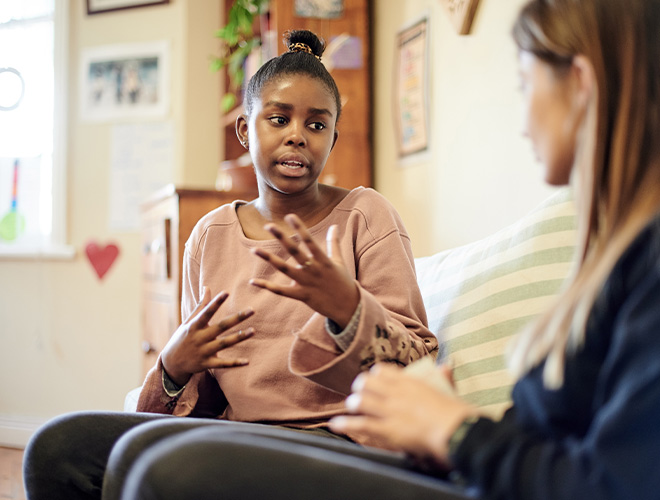
There is a particular kind of moment every parent of a teenager comes to recognize. Your teen is completely overwhelmed, crying or raging or shutting down, and every reasonable thing you say seems to make it worse.
In that moment, logic does not land. Their thinking brain has gone offline, flooded by emotion, and what they need is not a solution or a lecture. What they need is a way to get through the next few minutes without doing something that makes everything harder.
That is exactly what distress tolerance skills are for. Drawn from Dialectical Behavior Therapy, they are small, practical tools a teen can use to survive an intense emotional moment without making it worse. This guide walks through the most useful ones, including TIP and STOP, and how to help your teen actually use them.
What distress tolerance skills actually are
Distress tolerance skills have one job, and it is narrower than parents often expect. They are not meant to solve the problem or fix the feeling. They are meant to help a teen get through a crisis moment without making it worse.
This is a real shift in goal. When a teen is flooded, the instinct, theirs and ours, is to fix the thing causing the pain. But at the height of the storm, the thinking brain is not available for problem solving, and pushing for solutions usually adds fuel.
Distress tolerance buys time. It lowers the intensity enough that the wave can pass, so that later, when your teen is calm, the real problem can be talked through. Skills like asking for what they need using DEAR MAN are for those calmer conversations. Distress tolerance is for the storm itself.
When to reach for a distress tolerance skill
How do you know a moment calls for a distress tolerance skill rather than a conversation? The clearest sign is that your teen has stopped being able to think clearly.
You might see it as a racing, panicked energy, or as a sudden shutdown where they go silent and unreachable. Their words may turn absolute, everything is ruined, nobody cares, this will never get better. These are signals that emotion has taken the wheel.
Another sign is the urge to do something impulsive to make the feeling stop, whether that is lashing out, running, or hurting themselves. When the goal narrows to make this stop right now, a distress tolerance skill is the right tool, because its whole purpose is to get through that urge safely.
TIP skills for when the body is flooded
When a teen is at the very peak of distress, the fastest way in is through the body, not the mind. The TIP skill works exactly there. The letters stand for Temperature, Intense exercise, Paced breathing, and Paired muscle relaxation, and they shift the body’s chemistry quickly enough to take the edge off in minutes.
The T is for temperature. Splashing cool water on the face, or holding a cool, damp cloth over the eyes and cheeks, gently triggers a natural reflex that slows the heart and settles the body. This works through the body’s built in calming response, not through shock or discomfort, so cool is all it takes and nothing painful is needed.
The I is for intense exercise. A short burst of movement, running up and down the stairs, jumping jacks, or a fast walk around the block, burns off the surge of adrenaline that intense emotion floods the body with. Even a few minutes can noticeably lower the intensity.
The first P is for paced breathing. Slowing the breath, and making the exhale longer than the inhale, tells the nervous system that the danger has passed. Breathing in for a count of four and out for a count of six, for a minute or two, begins to turn the dial down. We cover this more fully in our guide to panic attacks in teens.
The second P is for paired muscle relaxation. As your teen breathes out slowly, they tense a group of muscles, their shoulders or their fists, hold for a moment, and then release on the exhale. Pairing the release with the out breath helps the body let go of the physical grip that stress creates.
The STOP skill for the moment before reacting
Not every hard moment is a full body flood. Sometimes the danger is a single impulsive reaction, a text about to be sent, a door about to be slammed, or words about to be said that cannot be taken back. The STOP skill is built for that split second.
S is for stop. The moment your teen notices the urge, they freeze, just for a beat, without acting. T is for take a step back, leaving the situation if they can, and taking a breath to create a little space.
O is for observe, noticing what is actually happening, the facts of the situation and what they are feeling, without judging it. P is for proceed mindfully, choosing the next move with their goals in mind rather than letting the impulse choose for them.
Practiced enough, STOP puts a small gap between feeling and action. That gap is often all it takes to keep a bad moment from becoming a worse one.
Self-soothing through the five senses
Some hard moments are not a sharp spike but a long, heavy stretch, a rough evening after a bad day. For those, self soothing through the five senses gives the nervous system gentle, comforting input that signals safety.
The idea is simple. Offer each sense something kind. For sight, a favorite photo or a calm view out the window. For sound, a comforting playlist or a familiar show.
For smell, a candle, lotion, or fresh air. For taste, a warm drink or a favorite snack eaten slowly. For touch, a soft blanket, a warm shower, or a pet curled up close. Your teen does not need all five, just one or two that genuinely soothe them.
Helping your teen figure out which skill fits
With a few tools available, the natural question is which one to use when. A simple rule of thumb helps your teen choose without having to deliberate in the middle of a crisis.
When the body is completely flooded and emotion is at a ten, TIP works fastest, because it goes straight to the body’s chemistry. When the risk is a single impulsive reaction, STOP creates the pause. When the feeling is a long, low ache rather than a spike, self soothing carries them through.
The real key is practicing these when your teen is calm, not inventing them mid storm. A skill rehearsed on an ordinary Tuesday is one their body can actually find on a terrible Friday.
What parents can do in the moment
What you do while your teen rides out a wave matters as much as the skills themselves. The most powerful thing you bring is your own steadiness, because a calm nervous system nearby helps a flooded one settle.
Keep your voice low and your words few. This is not the moment for questions, lectures, or problem solving, all of which ask an overwhelmed brain to do work it cannot do right now.
You can gently offer a skill rather than command it, something like, would a cool cloth or a few slow breaths help right now. Afterward, once the storm has passed, that is the time to talk, and to notice out loud what helped.
Many of these tools are ones you can learn and practice alongside your teen. Our guide to DBT skills for parents walks through several you can start using at home.
When getting through the moment is not enough
Distress tolerance skills are powerful, but they are not a cure, and they are not meant to carry a struggle on their own. If your teen is reaching for these tools again and again, or the crises are frequent and intense, that is a sign the underlying pain needs more support.
This is especially true when the urge in those moments is to self harm. If your teen is hurting themselves, or you find yourself worried they might, please treat it as a reason to reach out rather than a phase to wait out. Our page on teen self-harm treatment explains how we help.
Distress tolerance is one piece of the larger toolkit of dialectical behavior therapy for teens, which teaches these crisis skills alongside emotion regulation, mindfulness, and interpersonal effectiveness. Because our care is outpatient, your teen builds these skills while continuing to live at home and go to school.
When to seek help right away
Some moments call for immediate support rather than a skill or a scheduled appointment. If your teen ever talks about wanting to hurt themselves or not wanting to be alive, treat it as urgent, even if you are unsure how serious it is.
You can call or text 988, the Suicide and Crisis Lifeline, any time of day or night to reach trained support. If your teen is in immediate danger, call 911 or go to the nearest emergency room. Reaching out in those moments is never an overreaction.
Common questions from parents
What is the fastest distress tolerance skill in a crisis?
For the most intense, full body moments, the TIP skill tends to work fastest, especially cool water on the face paired with slow breathing. These change the body’s chemistry directly, which is why they can take the edge off within minutes, faster than anything that relies on talking or thinking. Once the intensity drops a little, other skills become easier to use.
Are distress tolerance skills just a way of avoiding problems?
No, and the difference matters. Avoidance means never facing the problem at all. Distress tolerance means getting through an overwhelming moment safely so that the problem can be faced later, when your teen is calm enough to think it through. The skills buy time and lower the intensity; the actual problem solving still happens, just not in the middle of the storm.
My teen refuses to try these when they are upset. What can I do?
That is common, and it is usually not defiance. In the height of distress the thinking brain is offline, so a brand new skill is hard to reach for. The fix is to practice these when your teen is calm, and to model them yourself, so the tools become familiar. In the moment, offer gently rather than insist, and let go of needing them to do it perfectly.
When should we get professional help for my teen’s emotional outbursts?
Consider reaching out when the crises are frequent or intense, when skills alone are not keeping your teen safe, or when the urge in those moments is to self harm. Structured support such as DBT teaches these skills more deeply and addresses the pain underneath them. An assessment does not commit you to anything beyond a clearer picture of what would help.
Getting through the hard moments is a skill your teen can learn
Learning to get through the hardest moments without making them worse is a skill, not a personality trait, which means it can be taught and it can be learned. Every time your teen rides out a wave and comes through the other side, that lesson gets a little stronger.
If the storms at your house are frequent or frightening, you do not have to weather them alone. Our is my teen a good fit guide is a good next step, or you can call us at 904-659-7473 or reach out through our contact page. We will listen and help you find the right path forward, together.