
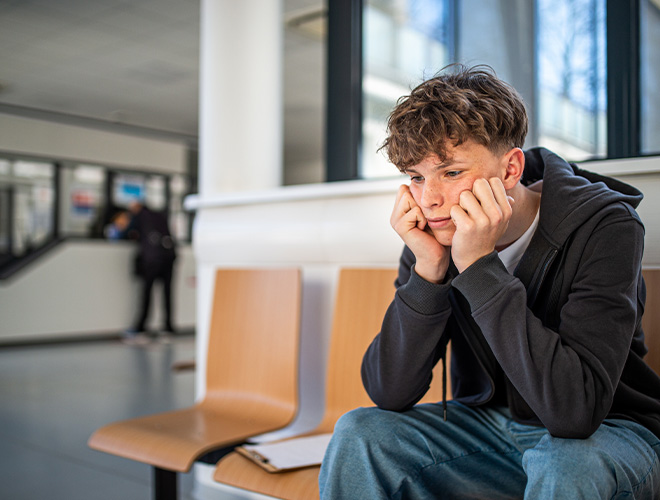
Some teenagers are simply quiet, and there is nothing wrong with that. Others are quiet because speaking feels genuinely dangerous, and telling the two apart from the outside is harder than it sounds.
Parents often notice it in small things first. A teen who will not order their own food, who dreads being called on, who says no to every invitation and then seems lonely afterward.
This guide walks through what social anxiety actually is, how it differs from ordinary shyness, the signs that are easy to miss, and how to help in a way that makes it smaller rather than larger.
What social anxiety actually is
Social anxiety is an intense fear of being watched, judged, or embarrassed in front of other people. It is not a dislike of socializing, and it is not a preference for being alone.
Most socially anxious teens want friendship badly. That is part of what makes it so painful, because the wanting and the fear pull in opposite directions at the same time.
The fear usually centers on a specific prediction. They will say something stupid, everyone will notice, and the humiliation will be unbearable. Adolescence sharpens all of this, since being seen and evaluated by peers is a bigger deal at fifteen than at any other age.
Shyness and social anxiety are not the same thing
This is the distinction that matters most, and it is the one parents ask about first. Shyness is a temperament. Social anxiety is a level of distress that gets in the way of a teen’s life.
A shy teen may take a while to warm up, then relax and enjoy themselves. A socially anxious teen often dreads the event for days beforehand and replays it critically for days afterward.
The clearest test is cost. Shyness might mean your teen is quiet at a party. Social anxiety means they do not go, or they go and spend the whole time in the bathroom, and it starts shrinking what they are willing to do.
Intensity is the other marker. Shyness feels like mild awkwardness that passes. Social anxiety brings a racing heart, a hot face, and a genuine sense of threat, which is a different experience entirely.
The signs parents miss
Social anxiety often wears a disguise, and the disguise is what sends families down the wrong path. It rarely looks like a teenager saying they are frightened.
It can look like rudeness. A teen who will not make eye contact, answers in one word, or does not greet a relative may be read as sullen when they are actually overwhelmed.
It can look like irritability, especially right before a social event, because anticipation is the hardest part. It can also look physical, showing up as stomachaches and headaches that appear reliably on school mornings.
Watch for the smaller avoidances too. Refusing to order for themselves, never raising a hand even when they know the answer, skipping class presentations, avoiding the cafeteria, or steering entirely toward online friendship over in person contact.
Why avoidance makes it stronger
Understanding this one cycle explains most of what happens next, and it is the reason well meant help sometimes backfires.
When a teen avoids something frightening, the fear drops immediately. That relief feels like proof that avoiding was the right call, and the brain files it away accordingly.
The cost arrives later. Because they never found out that the thing would have been survivable, the fear grows a little, and the next avoidance comes more easily than the last.
Over months this is how a teen’s world quietly narrows. Each individual escape seems reasonable, and the pattern they add up to is what needs attention.
When social anxiety shows up at school
School is where social anxiety does the most damage, simply because it is unavoidable and full of exactly the situations a socially anxious teen fears.
Presentations, group work, reading aloud, walking into a full cafeteria, and asking a teacher for help are all daily events that can feel genuinely threatening.
Sometimes it escalates into missed days that become a pattern. If getting your teen to school has turned into a daily struggle, our page on school refusal covers what tends to sit underneath that, and social anxiety is one of the most common drivers.
How to help without forcing or rescuing
There are two instincts to resist here, and most parents lean toward one of them. Forcing a teen into the deep end usually confirms that the situation was dangerous, and rescuing them from everything hard teaches the same lesson more gently.
The path between the two is gradual and collaborative. Pick something mildly uncomfortable rather than terrifying, agree on it together, and build from there once it stops feeling impossible.
Start smaller than feels useful. Ordering their own drink, asking a store employee where something is, or sending one text to a classmate are all real steps, and early wins matter more than fast progress.
Watch the accommodations you may not notice making. Ordering for them, making their phone calls, or letting them skip every gathering all bring immediate relief and quietly teach that they could not have managed it.
Praise the attempt rather than the outcome. A teen who went and felt awkward the entire time still did the brave thing, and that is the part worth naming out loud.
And resist the urge to reassure repeatedly. Everyone likes you, you will be fine works for a moment and then wears off, and a teen who needs it constantly is leaning on you rather than on their own evidence.
What to say when your teen is dreading something
If repeated reassurance is not the answer, it is fair to ask what is. The shift is small but it changes the whole conversation.
Instead of promising the fear is unfounded, acknowledge it and express confidence in them. Something like, I know this feels hard, and I think you can handle it, does far more than everyone will love you.
Asking what the plan is beats asking what is wrong. What time will you get there, and who will you look for, gives an anxious mind something concrete to hold instead of open space to fill with worry.
Naming an exit helps more than it seems to. You can text me at any point and I will come is not a loophole, and knowing an escape exists often means a teen does not need to use it.
Afterward, ask what went better than expected rather than how it was. It points attention toward the evidence that fear tends to overlook, and that evidence is what makes the next time easier.
Skills that make social situations easier
A few concrete skills take some of the weight out of these moments, and they are worth practicing when nothing is at stake.
Grounding techniques help in the moment when a room starts to feel like too much. Our guide to coping skills for teens walks through several that are quiet enough to use in a classroom.
Learning to notice an anxious thought without treating it as fact is the deeper skill, and our post on Wise Mind and mindfulness covers how that works.
Practical scripts help too. Knowing how to ask a teacher for help or say no to something makes the situation feel far less unpredictable, and our post on asking for what they need using DEAR MAN gives them a structure for it.
When it is time for professional support
Reach out when social anxiety is shrinking your teen’s world, when it is affecting school, friendships, or activities they once enjoyed, or when the gradual steps at home are not moving anything.
It also matters that social anxiety often travels with low mood, since a teen who has been isolated for a long time tends to feel it. If your teen ever talks about hurting themselves or not wanting to be alive, treat it as urgent and call or text 988, the Suicide and Crisis Lifeline, at any hour.
The encouraging part is that social anxiety responds well to treatment, often more predictably than parents expect. Our teen anxiety treatment helps adolescents face these situations at a manageable pace while building real skills, and because our care is outpatient, your teen keeps living at home and going to school throughout.
For steady day to day support in the meantime, our post on how to help a teen with anxiety is a useful companion to this one.
Common questions from parents
What is the difference between shyness and social anxiety?
Shyness is a temperament, while social anxiety is a level of fear that interferes with daily life. A shy teen may take time to warm up and then enjoy themselves. A socially anxious teen dreads the event beforehand, feels genuine physical alarm during it, replays it critically afterward, and begins avoiding situations altogether. The clearest test is whether it is costing them things they actually want.
Should I make my teen go to social events?
Forcing a teen into overwhelming situations tends to confirm that the situation was dangerous, but excusing them from everything lets the fear grow. The approach that works is gradual and agreed on together, starting with something mildly uncomfortable rather than terrifying and building from there. Praise the attempt rather than how well it went.
Will my teen grow out of social anxiety?
Some teens do become more comfortable as they mature, particularly with mild social nervousness. Social anxiety that is already causing avoidance tends not to fade on its own, because each avoidance makes the next one more likely. The encouraging side is that it responds well to treatment, and earlier support usually means shorter work.
My teen has friends online but not in person. Is that a problem?
Online friendships can be genuine and valuable, so this is not automatically a concern. It is worth a closer look when online contact has fully replaced in person contact, or when your teen wants face to face friendships but fear keeps getting in the way. The question is not where the friendships live, but whether avoidance is making their world smaller.
A smaller world can open back up
Social anxiety narrows a teenager’s life one reasonable seeming decision at a time, and it can widen again the same way. Every situation your teen faces and survives is evidence that the fear was not telling the whole truth.
If social anxiety is taking up more of your teen’s life than you would like, we are glad to help. Our is my teen a good fit guide is a good next step, or you can call us at 904-659-7473 or reach out through our contact page. We will listen and help you find the right path forward, together.